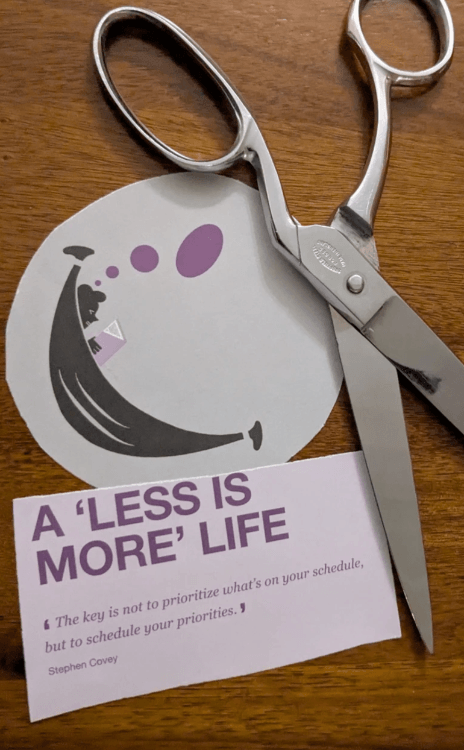
Recently I did something that most readers and writers might find unthinkable, including me. I picked up a book off my shelf and after a little while of trying to read it, I went to the cupboard and picked up a pair of scissors. It took a little while, and a walk outside, to steel myself to actually do it, but then I poured a drink, and set about the book with the scissors.1
If most of a book no longer speaks to me, but there are parts that do, is it so very wrong to take the shears and dismantle it, keep only what I can use, and sent the rest to be recycled?
It feels like there is. It feels like there still something sacrilegious about cutting open a book. I think that is race memory from the time when books were so rare, so valuable as artefacts, and so steeped in religion or philosophy, or science, that they were – by definition – sacred.
This wasn’t one of those.
And I'll readily agree that there are some of those still around...things that need to be treasured intact. I’m really not about to start tearing apart an ancient illuminated manuscript or an early atlas. This one was a mass-market paperback self-help text. One that I bought when I needed to hear everything it had to say, back when I answered all those questions about busyness and running-on-empty with a resounding heartfelt YES! Back when I desperately needed someone’s permission to stop.
Ask and it shall be given.
My permission to stop came in the form of quitting my day job, just before my partner’s unexpected and relatively sudden death – “after a short illness” in the traditional form of words – rapidly followed by a global pandemic that confined us all to quarters and severely limited our activity to a survivable minimum. I wasn’t just given permission to stop. Stopping was forced upon me. Eventually I learned to be grateful for that.
Somewhere along the line the book found its way to a shelf.
I went back to it on a day when I was low on motivation. I went to the less-visited shelves in search of something that might help. In my journal I had asked the universe for a nudge in the right direction. If this was it, then I was surprised, but far be it from me to second-guess my guardian
angels.
I started to read it and quickly found myself saying NO to all those questions about over-commitment, frazzle, the overburden of shoulds and oughts. I recognised that I do now have time to sit on the beach, or to take an hour or two to prune a shrub with secateurs and thoughtfulness, or to simply walk my neighbourhood and look at gardens and street art, or to go to the woods and write.
I realised, in other words, that I am no longer the target audience for this particular book. I have outgrown it . Just as we outgrow “Janet & John” when reading becomes something we can do without too much thinking, so the books that we kept with their turned down pages and scribbled margin notes also become things that we no longer need, when we have learned the lessons, or life has taken us away from needing to do so.
What then to do with such books?
To be honest I don’t think I ever had Janet & John, and only very few Ladybird books, but there were others: picture books, fairy tales, “annuals” based on the children’s comics. I’m sure they were all passed on to my cousin and thence who knows where. In theory, then, all the books I no longer want to return to my shelves would equally be passed on. Most of them are – either to friends who might enjoy them or through charity shops or occasionally just left in hotel rooms with a note saying the leaving was deliberate.
The ones in which I’ve scribbled my long forgotten angst though: I'm less comfortable putting them back into circulation. As against the grain as it goes, these tend to simply get a parting ‘thank you’ as I drop them into the blue bin. But they go in whole. This is the first time I’ve been a bit more brutal at the parting of the ways.
The thing is: amongst all the “this is no longer me” stuff, I did find quotations, illustrations and the
occasional idea that I can still work with, albeit from a different perspective than the one I had ten years ago. If I kept the whole book, kept the book whole, I would have returned it to my shelf, rarely opened it and never used it, because of all those pages where I was recognising who I used to be but am no longer.
So I took up the scissors, and cut out the bits that will rest a while in the prompt box and eventually find their way into future journals attached to future thoughts, where they will be of more use to me than they are on the shelf.
So in the end, I decide that it wasn’t a terrible thing to do at all. I wasn’t mutilating the book, I was harvesting from it. I’m sure that in the section on “how to use this book” it didn’t actually say “feel free to tear it apart” – but its whole ethos was that less is more, and to prune and focus, so I’m hoping the author won’t mind that I have done precisely that.
The book in question was Sháá Wasmund's Do Less, Get More (978-0241003671) and the snippets illustrated are from that book. If you're still steeped in busy-ness or overwhelm, I still recommend it. Can't give you my copy though.
