As I’ve said, I’ve been walking Guernsey for a fair few years now. I have a map. I have an internal visual of most of the layout of the island in terms of towns, villages, beaches, but at the same time: I have no sense of direction and the twisty-turning nature of lanes combines with the from-every-direction sea-light and sea-scent to throw me off whatever track I might have thought I was on.
Add to that my childlike delight in just going and looking and my Dad’s oft-repeated mantra that it wasn’t a proper day out if we didn’t get lost. Not seriously, life-threateningly lost. Though to be fair I could name a couple of occasions when we came close, the two of us…and a few more when I was, let’s say, at greater risk than I’m comfortable with when walking alone.
Then again, isn’t that the point? You need some level of risk in the being lost, even if it’s just the risk of a night in the open, or the risk of missing your boat and having no idea what to do if that happens, or the risk of running into the wrong people or no people at all, or the risk of wild animals, or the food running out.
These kinds of risks don’t apply when you’re just pootling around a small island with no plan other than getting back to base, eventually, and preferably before it gets dark.
Even the risk of darkness is limited. I have walked a few of these lanes in the dark before now. Not often enough to be comfortable with it, but enough to understand that I can do it. Do I need to add a hi-viz vest to my packing list? I have one, it would take up no room. It’s a thought.
It wasn’t a thought that occurred on the day. On the day, my thoughts to begin with were taken up with a deliberate diversion – and then with the intended destination – and then with the really bonkers idea that I might remember the previous route, in reverse, to get me home again.
At the end of the day, the thought was: well, that was a merry little interlude. Thoughts along the way shifted, ebbed and flowed, but let’s take it as it came…
The plan was to go back to Candie Gardens and to start by walking the cliff path into Town.
My first deliberate diversion was into the Fort George Military Cemetery, one of the many ‘heritage’ sites on this small island that has escaped my attention all the years I’ve been coming here. I have a suspicion my subconscious is saving things up to make sure I have reasons to return. Note to self: swimming in Fermain Bay is the only reason I need.
Fort George Military Cemetery
I’m not sure what I expected. Most likely I was expecting the ranks of headstones I am used to from photographs of foreign fields, and the ones I know from home, the ones that have names and ranks and regiments and the ones that say ‘known unto god’ for the unidentified remains.
I expected the standard memorial with the cross bearing the sword of victory, but not that the sword is not one of victory but of sacrifice. I wondered when that shift happened and why didn’t I know. The answer to both questions lies in my own ignorance. It has always been, by design, the Cross of Sacrifice. Perhaps this was the first time that I had seen it specifically so identified.
The Cross of Sacrifice was designed by Sir Reginald Blomfield for the Imperial War Graves Commission. His intention was that it be dignified, restrained and impersonal, to honour the collective sacrifice, the common mourning, rather than individual heroics. His design is an elongated Latin cross, the upstand stretched, the arms shortened, both octagonal in section, designed to be cut from granite or local stone. Embedded in the face of the cross is a bronze mediaeval long sword, blade downward in submission or stance, rather than upward in defiance or victory.
The Imperial War Graves Commission morphed into the Commonwealth War Graves Commission and their work continues. It is a requirement of all Commonwealth cemeteries with 40 or more war graves that the Cross of Sacrifice be placed among them. It can be found around the world, not just in the UK and her dependencies but across Europe, Africa, Asia and the Americas.
I feel humbled by how little I know about their work in remembering the fallen. I need to delve deeper. Another time.
Meanwhile, back at Fort George, I did not expect the 111 graves of German soldiers.
Simple dignified headstones, not too unlike our own, bear a cutting of the iron cross, the rank and name of the fallen. Regiments are not shown by name or badge – and I can understand the sensitivity of that. Ranks are listed in what I guess are standard abbreviations, only some of which I can guess at. There is a star against the date of birth and a Latin / Christian cross against the death date. Who were these young men – because most of them were young – how much did they know of the wrongs – because there were very few rights – of what they were fighting for? Did they even know where they were, much less why?
The cemetery is on a steep cliff-side. I walked the terraces as I would have had they been British fallen. Were the Davids and the Rothmeiers perhaps Jewish? And did they own it? Or had that part of it all not touched their families yet? Maybe they were horrors yet to come.
Was Hassdenteufel as pious as his name implies? Did Hermann Stevens have English ancestry? Was the assistant doctor Goebbels related to someone more infamous? I read the headstones and they gave me pause, each one of them making me think of something, or someone, or somewhen. But when it comes back down to the reality of it, who were they really, these, mostly young, men?
Someone remembers Obergefreiter Peter Oswald. They have placed a shell upon his headstone. He was thirty-six, eighty-four years ago. Most likely they only remember him from family stories. Most likely he was never more than a name to them. Most of the fallen are now only names to any of us.
I wonder again: who were they, really? What kind of men were they? How did they live, what did they believe? What jokes did they tell, what religion did they cling to? Did they swim down in Fermain Bay in thewaters that still wash in and out and turn the stones that were likely already
there back then? Did they walk the lanes in the Autumn sunlight, wondering as I do at how quickly the year has turned again?
It is not for me to say whether they have (or not) an equal right to lie at rest among the autumn anemones and white roses, with the soft whispers of a late Summer sea washing the shore that has long forgotten them. Someone thought to place a limpet shell on a headstone. Someone placed a pink pebble on another. Someone left behind a broken pair of sunglasses beneath the hydrangea.
I walked the terraces and read the names.
On other terraces, I stooped to read the unexpected names on the granite place-markers that could not be called headstones, or footstones, or gravestones…marker stones, memorials at least, dark granite carved with words that are already fading to unreadable. They speak of those I would not expect to find in a military cemetery with no explanation as to why they are…these are the graves of those who scarcely lived, the ones whose lives are marked in months or weeks, and who are given as little sentiment as the soldiers…only names and ages…and no personality. I can but assume that their parents were garrisoned here, and that they lived their whole short lives in this outpost of something that someone thought worth fighting for.
Perhaps somewhere there is a record of all of the people here: the German soldiers and the English ones, and the wives, and the children…perhaps somewhere there is an actual memory of who they were, or might have become…perhaps sometime we will learn that a memorial is no substitute for
an actual memory.
Perhaps this is why I come back to my family stories, as simple and unheroic as they are. Raise me no stone, my Dad once said…and I haven’t…but there are stories that need to be told…most of them are more or less written, but not yet told. There are other stories I am trying to put down on pages and files, with no idea if / how I will release them to the world, or allow them to be added to the record of lives lived, but somehow I do feel that it matters that we hold the stories, and that we set them free.
I wonder how many of the families of those young men know where they are buried, how many have come to see where they fell, how many have any idea of the real stories that lie between the carvings of a Star and a Cross.
Candie Gardens
I leave the cemetery feeling unexpectedly peaceful and walk down into Town and then up to Candie Gardens, which was the day’s object. I’d stumbled upon the park on my previous no-idea-where-I-am ramble into town, but on that occasion I had a pressing reason to continue on – which might not have been so pressing had I read the park notice board better – but you know, of a certain age and needs must!
Besides I had time to come back again and this time I had time to wander.
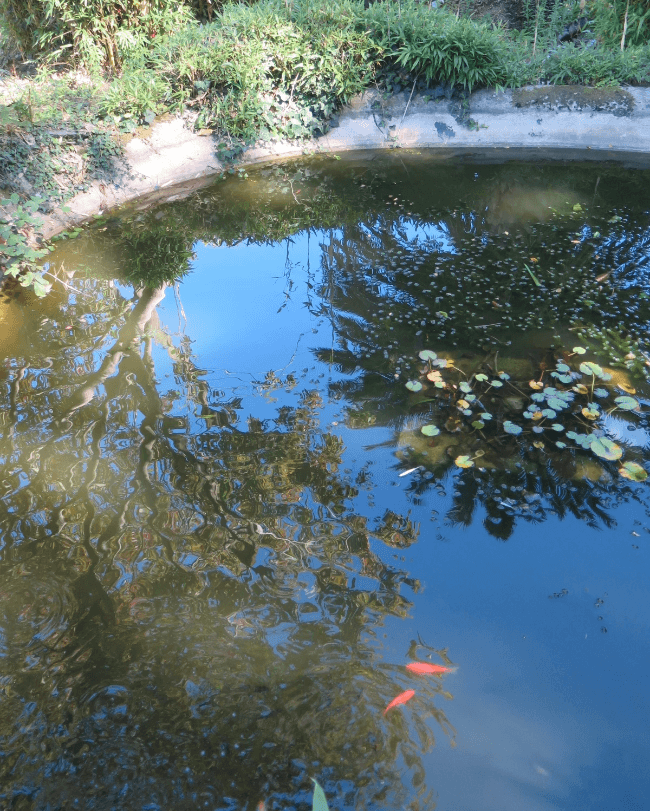
Not time enough to visit the Priaulx Library which is one of those things added to the reasons to return list. Not time enough even to visit the Museum at the heart of the gardens. But time enough to walk the looping paths…time to think about how it would have been as a private garden and what the Victorians would have made of it when it was first opened as a public space…time to pause by the artwork on the railings, loving especially Jenny Mahy’s Nerine Festival and Jacqueline Erskine’s Open Doors…time to catch the reflections of trees in the pools where goldfish swim…time to think about Victor Hugo trying to out-stride his granite block, deep in thought, his cloak billowing in a forgotten wind…time to look at the flower beds and the trees and the sun and shadows.
It seems to me that the point of a park is this idle wandering. It seems that on reflection perhaps I should have taken time to buy a coffee, to sit, and write.
Maybe next time!
The unplanned route
So far so good. I had walked down to this place only a couple of days ago. I knew where I was in relation to everywhere else. I simply needed to reverse that trail.
Yeah. Right.
Let me just say: thank the gods for Google Maps. Obviously I wasn’t lost. Not lost-lost. I just didn’t know where I was. I was walking on instinct and my instinct is not remotely linked to whatever limited sense of direction I ought to have. I kept walking, trying to keep a track of where the sea was – my bit of sea, I mean, the bit on the side of the island I was trying to keep to. I am obviously not very good at this. Even as I walked through the housing estates and old village remnants, the suburbs and beyond, I could feel the roads looping round and twisting about. I knew that I was not on the road I thought I could find again. I knew that I did not know where I was.
But you know what? It takes me a long time to give up.
Eventually I found that most delicious of things: a road sign.
Not only a sign, but one that told me which direction to go. "St Martins" it said pointing in precisely the opposite direction of what I would have thought…but those signs have been there a long time, and they’re not the kind that the local youth might prankishly swing round to annoy the tourists.
The sigh of relief was quickly followed by one of recognition. There was a church spire in view, one that I was sure I recognised…and so I walked up to Ste Marie du Castel. I have lunched within her yard in past years on my walking coast to coast. There was comfort in knowing where I was, in the certainty that if you gave me a map, I could place my finger upon it and say ‘here’ is where I am, and ‘there’ is where I’m going.
There was less comfort in knowing that I was closer to the wrong coast than the right one, and that without my paper map (yes, I know!!!) I was still reliant on my defective sense of direction. And the afternoon was stretching towards evening.
So against all my principles I dug the phone out of the backpack and plugged myself into Google. Asked for directions. And dutifully followed them, checking regularly to make sure I hadn’t missed an obscure turn, until I found myself on the outskirts of St Martins, back on roads I know.
It was a pleasant walk, for all my uncertainty.
Google took me down sunken lanes, where the tarmac is five or more feet below tree-root level, where the sun creeps through branches already shedding their first leaves, past fields where beautiful caramel-coloured cows look at you with inquisitive surprise, where autumn flowers insist that summer is not yet over.
It took me through hamlets where children on bicycles expended after-school energy racing up hills trying to make the green light so they would not lose momentum.
It took me onto a long ‘straight’ road back into my village. Straight in the sense of just stay on it, not straight in the sense of linear. It wound and twisted as much as any of the others, but it was easy enough to follow…and slowly I became un-lost.
And at the end of the day, I had only walked about six miles more than I had intended when I set out, which in itself made me think of one of my later walks with my Dad…the one where an eight miler turned into twenty because we’d ended up in entirely the wrong river valley.
I love my late father for many reasons and among them is that he taught me that the adrenalin of being lost is a good thing…to use it to fuel your imagination, your creativity and most pressingly your options for solutions. Even so, I will honour the better teaching in future which includes the fundamentals that the compass and the map are no effing use unless they’re actually in your pack!
All in all though...it was a good day.
~
