Rummaging in the back-office files for something specific that I felt would be a good lead
into a piece I wanted to write for submission, I also came across a document that starts “Six weeks of writing outside, so what have I learned?”
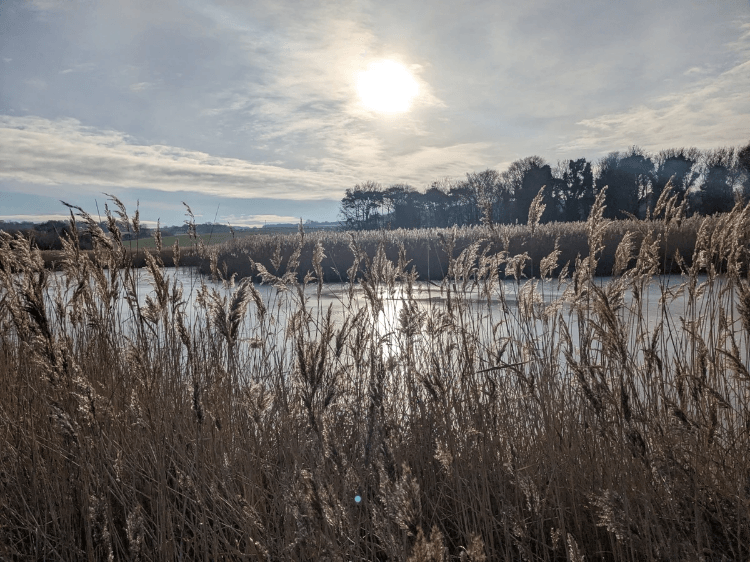
It was February 2020 and I had just completed a six-week (one day a week) course of Creative Writing Outside on the Cley marshes.
It was a time when I desperately needed two things: a reason to go back out into the world
and stimulation for re-energising my writing.
This was pre-lockdown. This was a month before we all learned the hard way how small the world had become and how we, as individuals, would respond to having our personal worlds shrunk to the bare minimum.
For me personally, it was a time when I still dealing with grief and overwhelm and still trying to envisage a new life for myself, without really knowing what I wanted it to be. I was still working part-time. I was freelancing and could choose my hours so long as the work got done. I’d already quit the bits of the job I resented and was slowly getting bored with the rest of it.
In hindsight I can see that what was happening to me in 2020 was the gradual recognition that ‘retirement’ (in every sense) was both something I was actively resisting and something that was calling very strongly to my soul. I was birthing the need to withdraw from pretty much everything that had made up my life to date. With due apologies to the world at large, the pandemic eased that transition for me. I had no idea that lockdown would be such a gift.
I wouldn’t understand that, until a year or so after we had re-emerged into the wider world.
Six years after that first course, which left me anxious enough to need to distil the point of it on the page, I still attend season on season, even though we walk many of the same paths, read many of the same poems and prose pieces as openers, do the same starter exercises. I am still learning.
Technically, it is still a repeated series of workshops. Also it is something else: it is an open and fluid community of writers. I am not the only one who comes back season after season.
Six years on, I know many of these people to greater or lesser extent. Some I count as friends and connect with, meet up with, and talk to outside of that space. Others I only connect with within it. In both cases, we share a lot more of ourselves and our lives than I would have ever anticipated. The post-lockdown sensibility may have had something to do with that.
Although many return, the group remains fluid. Most seasons someone new comes along, and the community expands. Each time the dynamic subtly shifts…but only subtly...only enough to be interesting, rather than disconcerting.
At the same time of my beginning at Cley[i] I became a member of another group: this one an on-line, global, all-female space. A very different environment. A different community. Equally porous at the edges. The similarity is that there are those who show up every week that they physically can, and those who come for a while, take a break for a while, and are welcomed back whenever, and others who drop in and out as life permits. The similarity is also that new people come along all the time and are warmly welcomed. The similarity is that many of the rituals and writing practices are surprisingly synchronous.
I have a friend who often talks about wanting to be part of “a community” and when he does so, because of the way he does so, I have a vision of something like a mediaeval village, with a fixed number of people: very few adventurers abroad, very few incomers, a “like-minded” way of living. He explicitly says that he wants to be in a community of like-minded people.
I don’t want that.
I don’t want to surround myself with like-minded people.
I’m not going to learn anything from people who think like I do.
Like many writers, I spent a lot of my life feeling like I hadn’t found the place I belonged. I’m beginning to realise that the reason is that I was looking for “the place” – and that my restless curiosity, my need for movement and stillness, my interiority and my externality, my desire for solitude and connection, would not be happy with one place.
It would take finding a bunch of different places where different parts of me belonged – and it would take the soul-searching necessary to understand the ok-ness of that – before I would find both courage and contentment.
I found that – the courage and the contentment - by finding communities (plural) where I belong: on the Cley reserve, in theTuesday morning zoom room, and coincidentally in a dance studio and a swimming pool, on a beach, on an island, in an ongoing fairy tale, in my back garden that somehow became a tai chi teach-space.
I have found that I don’t need to shrink myself to one version of who I am.
It amuses me that all of my writings from the Cley workshops continue to go into a header folder labelled “Personal Development”. I clearly intended that first series to be time-limited.
Meanwhile, all of my first writings from the women’s circle are hand-written in my journal. Mere scribbles. Some are shared in the space, most are not. Some of it eventually demands to be sent out into the world. A lot of it deserves to be protected from the ridicule it would rightly attract if it were.
In both cases, a lot of it is compost.
I had to re-write that sentence before I committed it to the page. In my head it read: a lot of it is just compost. I abhor that limiting word ‘just’ (in this sense of meagre or minimalizing). A lot of what I write in the field and in the zoom room is compost. Rich, fertile, unconnected matter that needs to rot down and heat up and get mixed and stirred before I can do anything with it.
Compost! Not “just compost”.
So here I am, six years on, rummaging in the compost heap. On this occasion, not because I think the fragments will have become something, but to see how much has changed, and how much has stayed the same.
Back then I wrote that there is merit in what I’m doing, even if I’ve yet to figure out what it is.
I now have a clearer vision. I know I’m doing what I am meant to do – in all my various writing projects – and for each of them I know why.
I wrote that: I may be a writer, but I’m not a poet.
How wrong can you be?! I am a poet. Maybe not a very good one, but I have a prize or two, a few published pieces, that attest that sometimes my words work.
I wrote: there is a difference between poetic and romantic, and my soul is the latter. I come to the world through myth and legend, a sense of the sacred and a fundamental belief that we are simply part of a system that we haven’t begun to understand.
I have no idea what I meant by that first sentence. The rest of it still holds true. The writings of Sharon Blackie are helping me to take this deeper.
There were other things I wrote back in 2020 that I still find resonate for me now. Here are some of my notes from along the way…
I’m coming to this from the opposite end to most participants. Where most are seeking the language to express the love for (and knowledge of) the natural world, I’m starting from my love of language, of history, continuity and the spiritual.
I write from the heart and not the head. I cannot construct a piece; I can only let it flow. Once I have the door to step through, the starting phrase or notion, then everything else simply follows, inevitably. Though not un-edit-ably: there is always work to be done when I get to the end.
…when I do ‘construct’, I’m never happy with the results. They always feel forced.
…I still hold two things to be true:
We see the world not as it is, but aswe are.
(Anaïs Nin)
And
We should only write what needs to be written
(Nan Shepherd)
I don’t have the knowledge or the patience to be a nature writer in the traditional sense. I know that these can be learned (and who knows, maybe I will?). I do have the curiosity, but I don’t have the externality. Believing as I do, that we are just another animal, I respond to nature from within it, rather than from outside.
I have a simplistic approach to poetry. I am from the old school of rhythm and rhyme, where poems are part of the oral tradition, written to be spoken. The developments that focus on how the words look on the page, I find irritating, irrational almost. I can see that they are clever, artful, but maybe too much so. That’s not a value judgement, merely a personal response. The poems I love, I love for how they sound, not how they look. A childish approach perhaps.
I am not above foraging for imagery and recycling gathered words.
I don’t have enough words for the colour green. Or blue.
Maybe I’m not so much creative, as re-creative.
I probably do spend too much time in my own head.
Writing on demand is exhausting.
That I love difference. C. talked about the clouds across the moon after the storm, explaining the climatic system, and there was a hint of what I suspect is a love for systems, for the scientific, for the detail – and there is beauty in that too. And intrigue. I was also out that night watching the clouds – but I saw Valkyries. Like I said, an unashamed romantic! I think the world needs both: the science and the romance.
That it’s ok to be un-inspired.
That I’m more likely to look closely with a camera in my hand, than with a notebook.
That I can only take so much stimulation before I need to ‘escape’ to allow things to permeate or dissipate, so I can play with what’s left and see what it connects with.
That I have opened the door to a whole other floor of the library, with even more books that need to be read – exposed whole other gaping holes in my education.
That I am way out of my depth – but still swimming.
In 2026, having just completed the latest Cley season, I still feel much the same way. I am still out of my depth and still swimming. The difference is that now I know I can swim, or at least tread-water.
The difference is that now I know I belong in the water with these people. I don’t need to do what they do. I need to keep stroking and kicking and keeping my head (mostly) above water. I need to crawl out onto land and lie in the sun from time to time. I need to remember the garden and go turn that compost over from time to time. And that I can mix up my metaphors any which way I choose.
I need to listen to others about their process. I don’t need to emulate it.
[i] I say ‘my’ beginning because the workshops had already been going some years before I found them. 2026 will see the 10th anniversary - and on we go! For further information check out the Norfolk Wildlife Trust website.
