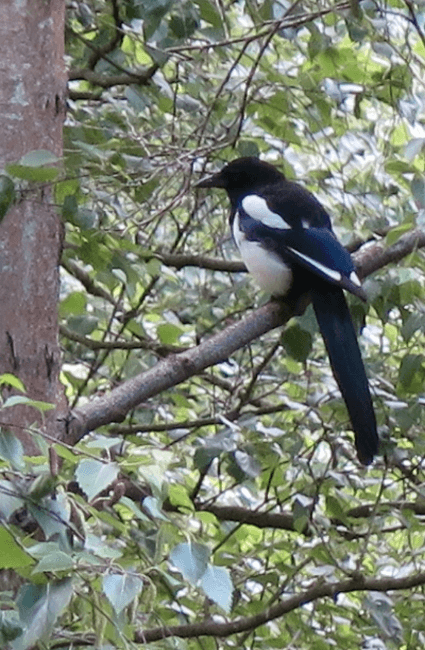
It had been a week of sad news. A friend described loss as a familiar companion. Sometimes it does feel that way. Some days I wake from dreams of the people who no longer walk through my life. Such dreams are not easy to shake off, especially when another passing is bright on your radar. Such dreams take you back, and not always in a good way, and they cast a pall over the bright future you work so hard to imagine for yourself, even now. On mornings like that, when the heatwave has passed and the rain has refreshed and you’re already wishing it would stop for a little while, it is no surprise to find the solitary magpie hopping about the garden.
One for sorrow…
I salute it automatically. It ignores me. It has found foxgloves, and I have found an answer to an earlier question. The flowers bloomed almost overnight with the first flush of rain after the heat. Bursting spikes of thimbles, pinks and mauves, speckled delights. Almost as quickly they seemed to lose their flowers. I assumed that the torrential downpours we’d had, short but sharp, had washed them out, until this morning. A magpie carrying away a foxglove cup. I don’t know whether it intended to eat it – are they immune to digitalis, do they sometimes benefit from it? – or whether it was just another shiny thing to be possessed, to decorate the nest.
There is a nest somewhere abouts, quite close to the house.
Give me a choice of bird-call wake-up-alarms, I’d probably choose the sweetness of robin or the softness of woodpigeon, maybe the deep note of the owl. I would not choose magpie. Cards on the table, I love them for who they are. I know they take smaller birds, but anyone with a family to feed does what they can…when folk mourn the blue tit, they spare no thought for the worm.
Magpies are very handsome birds, I crave one of those velvet blue wing feathers for my altar, and I am happy to have them around, but still and all, I would not choose their call as my good-morning singing-song.1
It is not a song. It is hardly a call. The words that come to mind are mechanical, ratchetty, scraping. To be honest the first morning they pulled me from my bed, I actually went to the window to see who was street-cleaning or woodworking or whatever at such an early hour. It took me a while to figure out that I was listening to a nest.
It’s not the demonic laughter of some other crow family members. It’s not humanic or avian at all. It sounds like an unoiled robot, clirricking along, occasionally squeaking round the corners. A friend used the word ‘industrial’.
This morning I’d been spared that, perhaps because I was up before they were and was watching from a different part of the house.
Three for a death…
I didn’t witness the second move in. Suddenly there were three. The behaviour suggests that the smallest was a juvenile, still being fed by the adults. Not foxglove flowers I’m pleased to say, fruit found from somewhere, possibly my own strawberry patch, worms or grubs from the damp soil and the crevices of the rockery. They hopped about, found and ate whatever food was around and flew off towards the west.
Two for mirth…
Days pass, and I re-take to walking around the cemetery. Possibly the young are now gaining their independence, because now I do find the adults more often in pairs. There is something playful about them as they hop around the headstones… stones largely disfigured at the moment by gharish yellow labels marking them as ‘unstable memorial – do not attempt to remove this label – contact the cemetery management’.
I am delighted by the birds and offended by the labels. It may well be true that many of the headstones are unstable, but as none of them are above two foot six inches tall, they are hardly likely to come crashing down and killing some kneeling mourner. The trees are a more imminent danger – dropping branches every storm, and acorns, chestnuts, limes, just as a matter of course, or littering the paths with slip-hazard leaf-fall every Autumn. Please don’t tell them I said that, or we’ll see the clear-felling of this gorgeous city woodland.
Every memorial is unstable…in every sense. The memories fade. Graves eventually go untended. In the older part of the cemetery they totter and tumble as the Earth reclaims her own, fed on body and wood, she reaches up to pull back down stone. This is the natural order of things. The violent littering of memorial grounds with plastic twine and offensive, indeed threatening, labels is beyond insensitive. “Do not attempt to remove this label” suggests that the whole might self-destruct at such an attempt blowing the contents of the grave skywards as a lesson to those who merely care about desecration, because that’s what this is. I want to sneak in one night and remove them all.
This is a place where there are strict notices about plastic decorations being a threat to the wildlife of the place, so there is also a measure of hypocrisy here among all the rest.
I let the magpies lead me away from it. Up into the trees. Down the paths away from the municipality into the older, wilder sections…where the stones are eroded, and fall at will, where the grass is uncut and large white butterflies sunbathe…where a flash of brown across the path is a muntjac heading for deeper shadows.
I walk through the artificiality of the memorial garden to the pond where fountains aerate the water and surprisingly large fish gather in the patches of sunlight, and tiny golden ones gulp, mouths out of the water as if they’re trying to breathe pure air. I don’t know, but assume they are feeding on insects I cannot see. From there back into the woodland shade, the uncut grass hiding forgotten burial plots, visible headstones so eroded that only the basic shape of them remains, no names, no dedications, no elaborate chiselling of emblems or symbols.
In other places short phrases catch my attention. A daughter of the First Nations - all I can think is that she died a long way from home. Elsewhere “With Respect” complete with its inverted commas makes me smile; I can’t help thinking it is a wry reference to an oft-used phrase.
There is something about walking the cemetery, the older fields in particular, that automatically slows my steps. To walk quickly here would be as unthinkable as skipping in church - though, to be fair, I might once have done that.
In the deeply wooded area, despite an absence of obvious flowers, there is a soft hum of unseen insects that might also be the whispers of communing souls. Trees hold droplets of seed-cases in shades of soft greens and subtle browns. Grass bows to the wind. The height and girth of some of these trees speak to the shortness of our stay on earth – for those whose custom is burial, they will spend far more time under it than walking upon it – strange then that we pay so much less attention to the more fleeting, aliveness, of a life, and prefer (it would seem) to memorialise it afterwards. I beg to differ. Let me live while I'm alive. If I'm forgotten thereafter, I suspect it won't matter much.
The birds here are the less obviously flamboyant. I think I hear wren, definitely blue tit. A robin alights on a nearby branch, cocks its head and flits away. A jay bird sweeps low across my path and away up into the tangle of branches. I catch another sight of a tan hide skipping across the path in the dapples of leaf shadow.
I also head away, back to the more open spaces where my maggies are at play.
1 I am talking here about the Eurasian magpie, common to Great Britain, which is a completely different and unrelated species to the Australian magpie which I'm led to believe has quite a melody at its disposal.
