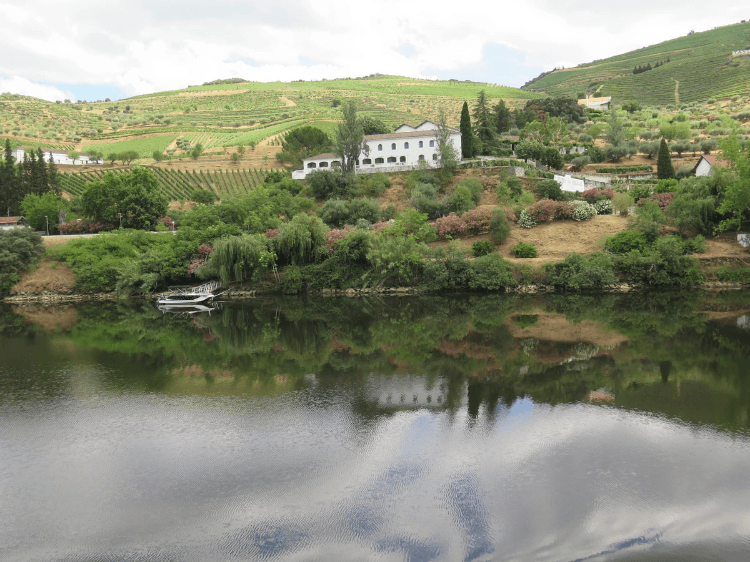
“What was your favourite bit,” people ask – the official (dreaded) feedback questionnaire and curious friends. I try to remember. From a single week of floating up river and back down again, a few days of half-day excursions and lots of not doing anything very much – not even the writing I’d had in mind to do – it should be easy enough to say “oh, this was amazing!”
The reason it isn’t so easy is not because I cannot answer the question. It is because of what the answer is.
I’ll get around to talking about where we went, what we saw, what I learned along the way. Things that will be interesting to some and not others but were to me…the things that found their way into my Morning Pages and scribbles…things I’ll never work into a dinner party conversation, but will lever in anywhere else I can manage. But first, I’ll answer the question.
My favourite bit was watching the river bank drift past.
I use the expression ‘river bank’ somewhat loosely. It was mostly terraced hillside, interspersed with blasted rocky canyons. It was bridges, some of them low enough to touch, where those of us on deck were literally instructed to ‘sit down’ and ‘duck’. Bridges by Eiffel. Bridges of more recent ironwork carrying railways that are too slow for modern travellers but that I want to come back
and ride. Bridges of ancient stone. Bridges of graceful curves that we could see better from the road.
My favourite bit was being in my cabin with the the wide windows open, feeling the breeze, watching the shifting shadows in the water, the terraced vineyards, the pretty little towns. It was trying to figure out where the hidden roads were that connected these places. It was white walls and red-tiled roofs. It was the morning mooring where I watched an old man in a grey vest and a baseball cap, gently watering his yard. It was the locks.
Oh, the locks.
Forget those hand-wound staircases up English canals. I’m talking about a 36 metre lift, in a single haul, with a full width of 12 metres and an 11 metre 40 centimetre boat. The waiting for our turn with the boat banging against the wall, crew members fore & aft shouting and signalling to each other. The drop in temperature as the gates close around you. The slow start to the climb (or drop) and the speed that it picks up. The lichen that grows on the walls where their tar cover has eroded. The house martins that nest on the underside of the dam wall. These lochs are not just lochs, they’re river management, intended to soften the flow of the waters, ease the passage of traffic, they’re dams, hydro-electric generation. They have changed the life of the Douro.
We watched a film from when the barrels of wine were brought down from the vineyards on barques…wind-sailed, man-oared, mule-pulled…and the empty barrels were take up stream the same way. Back then the Douro was a white-water-rafter’s dream. A sequence of cascades and rapids. If you look closely along the banking hills, you’ll spot tiny chapels…each of them marking
a particularly dangerous stretch back in the day…each of them an opportunity to offer up another prayer for safe passage.
It is hard to imagine all of that now that the river has been tamed.
I watched from my cabin, having configured my pillows and cushions to offer the best angle of view. I watched from the sun deck – in sun, in shade, lounging, sitting, leaning on railing. I kept reaching for my camera or my phone. I kept missing the picture. I kept capturing the moment in mind. I spent long uncounted times without reaching for a photographic device. I wrote well-nigh none of it down.
I let go most of the guest speaker’s efforts to entertain and educate us (feel a little bad about that) but really, I just wanted to be at the rail, on the deck, somewhere I could watch the place as it is. I can look up the academic stuff later. I might do. I might not.
For this one week I let everything go, including my own intention to write. I settled into the river, into the shadows, reflections. I watched the impressionist paintings of treescapes during the day. Lapsed into the romanticism of underlit bridges after dark.
Took deep breaths when I saw a heron – every time. Look! I wanted to say, but had no-one to say it to before it was gone. Loved the house martins soaring and catching and returning to young-full nests built onto the underside of the dams. Watched the black kites and Bonelli’s Eagles.
I loved the way terraces of vines and olives emphasised the curvature of the landscape…the way ploughed fields do in England: imposed lines undulating with the land beneath.
In the more inland valleys we were struck by the number of dovecotes, or more likely pigeoniers, not doves as I would know them, wild pigeon. A major source of food in “the olden times”.
Whenever that was.
Over the course of a week I learned that Bruno used “the olden times” to mean anything from the eleven-hundreds to the nineteen-sixties. Perhaps in some of these rural communities not much changed over those centuries.
I’m used to travelling with a map, to knowing where I am. Not this time. I started trying to keep up by way-station, by mooring, by lock…but I gave it up as really not mattering very much. I would see what I did and miss the rest. I learned to be grateful that the navigation of the river during the night is not permitted, so although there were mornings where I woke up to discover that oh, we’re moving, we had not been doing so for very long.
There were occasions when we did disembark at one landing and re-embark further up – or down – stream, which we learned later was part of Captain Fabrice’s negotiations with other boats and moorings and etc to ensure we got the easiest of landings. There were a few cases where we were double- or triple-parked and my expected morning view was replaced with a peak into someone else’s cabin on some other ship. Or not. Mostly they were better at keeping their curtains closed than I am. But in the grand scheme of things they were few and mostly I had a river view, not a boat or dock view. It is possibly the best way to start a day.
I understand why people choose to live on riverboats.
It wouldn’t work for me, though, I have too much ‘stuff’ for one thing and, more crucially, a serious need for “space” – indoor space and outdoor space. I can camp and I can do shipboard life, but only because I know it is an adventure and there is an end date.
My favourite bit was the bus journeys from the boat to wherever was that day’s destination, again watching the land pass me by, listening to Bruno telling us whatever came into his mind, about Portuguese history, Portuguese life, culture.
My favourite bit was being passive, a sponge. Scribbled notes, snatched photographs, and a lot of just soaking it in and hoping I would remember.
I remember…
…how silver the evening was, our first night in Porto, there were clouds and temperatures in the low twenties, when London was sweating in the mid thirties;
…wanting to get down to the Porto's quayside, which our tour did not allow time for;
…a portrait on a party wall, exposed by demolition, peeling and unknown;
…tiled façades and wrought iron balustrades;
…fading grandeur;
…blue and white tiles – everywhere;
…gardens and grapes and the increasing heat, tasting port, drinking water;
…cathedrals and chapels.
I remember granite, and sandstone, and how they colour the lives of the people who live a-top them.
Mostly, I remember the air – how still it could be, and how wild the wind was one day – and I remember the water, the ever shifting waters of the river.
I remember Isabel, into her 25th year of leading tours up and down the Douro and still taking pictures because "I LOVE the river, the reflections, the shifts."
Me too, Isabel, me too.
More on the detail, next time
